
Sustainable Craft Entrepreneurship:How E-CRAFTS Connects Tradition, Digital Skills and a Greener Future

Across Europe, craft has always been connected to sustainability. Long before circular economy became a policy priority, artisans were already repairing, reusing, transforming and giving value to materials. A piece of fabric could become a handmade bag. Leftover wood could become a decorative object. Old techniques could be adapted to new needs. Craft is often based on patience, quality, creativity and respect for materials.
Today, these values are more relevant than ever.
Europe is moving towards a more sustainable and circular economy, where products are designed to last longer, resources are used more carefully and waste is reduced. At the same time, digitalisation is changing how small producers reach customers, tell their stories and sell their work. For women artisans, this creates an important opportunity: to combine traditional craft skills with digital entrepreneurship and sustainable business practices.
This is one of the key ideas behind E-CRAFTS. E-CRAFTS supports women at risk of social exclusion by helping them develop digital, entrepreneurial and e-commerce skills in the craft sector. The project recognises that many women already have valuable creative abilities, but need practical support to transform those abilities into sustainable economic opportunities [1].
Craft as an alternative to throwaway culture
In many consumer markets, products are produced quickly, used briefly and discarded easily. Craft offers a different vision. Handmade products often carry emotional, cultural and environmental value. They are usually made in smaller quantities, with more attention to detail, and with stronger links to local identity.
This is closely connected to the European Union’s circular economy priorities. The European Commission’s Circular Economy Action Plan promotes the idea that products should be designed and used in ways that prevent waste and keep resources in the economy for as long as possible [2]. The EU Strategy for Sustainable and Circular Textiles also highlights a future where textile products placed on the EU market are more durable, repairable, recyclable and produced with respect for social rights and the environment [3].
Although not all craft products are textiles, the principle is broader: Europe needs production and consumption models that value durability, repair, creativity and responsibility. Women artisans can contribute strongly to this transition.
A handmade product is not only something to buy. It can also be a message against overconsumption. It can show that local skills, small-scale production and responsible design still matter.
Why digital skills are essential for sustainable craft businesses
Sustainable products need visibility. If women artisans cannot present their work online, they may remain invisible to potential customers, partners and supporters. This is why digital skills are not separate from sustainability. They are part of it.
Eurostat reports that in 2025, 60% of people aged 16-74 in the EU had at least basic digital skills, still below the EU’s 2030 target of 80% [4]. This means that a significant part of the population remains at risk of being excluded from digital opportunities.
For women artisans, digital skills can make a practical difference. They can help them:
present their products through clear photos and descriptions;
explain the story and materials behind each item;
reach customers beyond the local market;
communicate directly with buyers;
manage orders and payments;
build a small but recognisable brand;
promote sustainable values through storytelling.
E-commerce is also becoming increasingly important for European enterprises. In 2024, EU enterprises generated 19.49% of their turnover from e-sales [5]. This confirms that digital markets are no longer optional for many businesses. For small craft producers, however, entering these markets requires training, confidence and support.
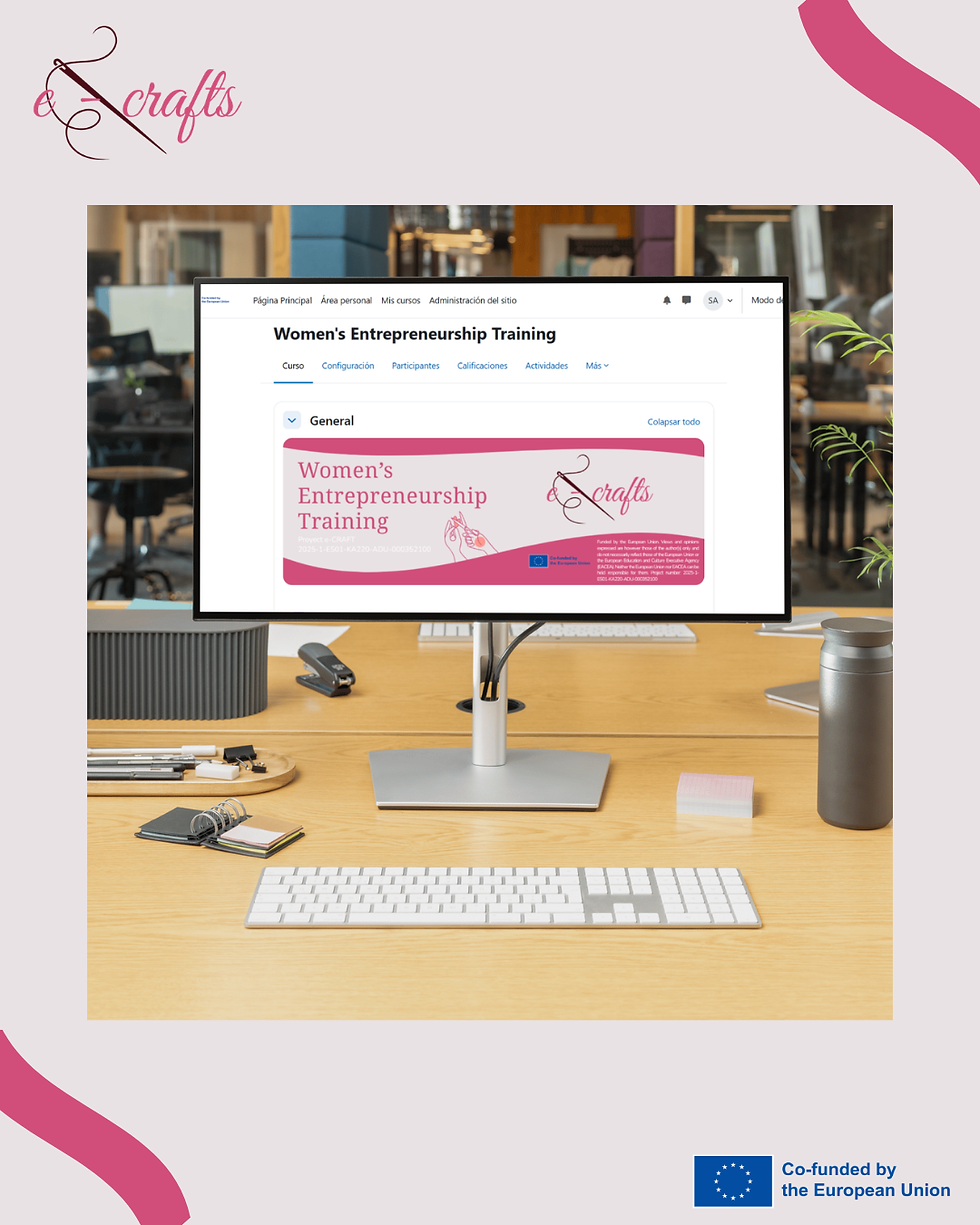
E-CRAFTS responds to this need by developing a MOOC, a digital platform, workshops and mentoring activities that help women move from basic digital learning to practical application in the marketplace [1].
The power of storytelling in sustainable entrepreneurship
In craft entrepreneurship, storytelling is not decoration. It is part of the value of the product.
Customers increasingly want to understand what they are buying. Who made the product? What materials were used? Is the production process responsible? Does the purchase support a local creator? Does it help preserve a traditional skill?
Women artisans often have powerful stories, but they may not always know how to communicate them online. Digital storytelling can help them connect their products with their personal journey, their community, their culture and their values.
For example, a handmade textile item can be presented not only as a product, but also as the result of a technique, a local tradition, a sustainable choice of materials and the work of a woman building her own economic independence. This kind of storytelling can strengthen both visibility and customer trust.
Through E-CRAFTS, participants are encouraged to develop not only technical skills, but also the confidence to present themselves and their work. This is especially important for women at risk of social exclusion, who may have experienced barriers to employment, education, entrepreneurship or public participation.
Sustainability also means social inclusion
Sustainability is not only environmental. It is also social.
A greener economy should also be an inclusive economy. If digital and sustainable transitions benefit only those who already have access to training, networks and resources, inequalities will continue. Women facing economic, social or structural barriers need targeted support to participate in these transitions.
The European Commission promotes women’s entrepreneurship through tools and networks that provide access to training, mentoring, advice and business opportunities [6]. EIGE also underlines that women’s digital inclusion is an empowering process, giving women a voice and enabling them to participate, innovate and shape the future [7].
This is strongly aligned with E-CRAFTS. The project does not treat women only as learners. It treats them as potential entrepreneurs, creators and active contributors to local development.
By supporting women artisans, E-CRAFTS contributes to several forms of sustainability at the same time:
economic sustainability, by helping women create income opportunities;
social sustainability, by reducing exclusion and strengthening confidence;
cultural sustainability, by preserving and renewing craft traditions;
environmental sustainability, by promoting responsible production and consumption;
project sustainability, by creating tools and networks that can continue beyond the project period.
Local crafts, European value
The cultural and creative sectors are an important part of Europe’s identity and economy. In 2024, women represented 49.6% of cultural employment in the EU, with the gender gap in cultural employment reaching its lowest level in the last decade [8]. This is an encouraging sign, but equal participation in employment does not automatically remove all barriers.
Many women in craft-related activities still face difficulties in scaling their work, accessing markets, gaining recognition and combining entrepreneurship with family or care responsibilities. For women at risk of exclusion, these barriers can be even stronger.
E-CRAFTS brings European added value because it connects partners from different countries around a shared challenge. The barriers may look different in each local context, but the need is common: women artisans need accessible training, digital tools, mentoring and support networks to participate more fully in the digital economy [1].
At the same time, the project respects local realities. Craft is local by nature, but digital entrepreneurship can help local products gain European visibility.
Towards a more responsible digital marketplace
Digital marketplaces are often associated with speed and competition. E-CRAFTS proposes a different approach: a marketplace can also be a space of inclusion, learning, cooperation and responsible entrepreneurship.
The E-CRAFTS platform is not only about selling. It is about helping women understand how digital business works, how to present their products, how to connect with others and how to build confidence in their entrepreneurial potential.
This is important because sustainability cannot depend only on individual effort. It requires ecosystems. Women artisans need trainers, mentors, local organisations, social economy actors, adult education providers, municipalities, craft associations and customers who understand the value of responsible production.
When these actors work together, craft can become part of a broader movement: one that connects tradition with innovation, local production with digital tools, and women’s empowerment with sustainable development.
Conclusion
The future of craft in Europe is not only about preserving the past. It is also about giving artisans the tools to shape the future.
Through digital training, e-commerce, mentoring and support networks, E-CRAFTS helps women transform craft skills into opportunities. At the same time, it promotes a model of entrepreneurship that is more inclusive, more local and more sustainable.
In a world of fast production and fast consumption, handmade work reminds us that value can also be slow, careful and meaningful. With the right digital tools and support, women artisans can bring this value to wider audiences while strengthening their own economic autonomy.
E-CRAFTS shows that sustainability is not only about what we produce. It is also about who gets the opportunity to produce, participate and prosper.
References
E-CRAFTS Project Documentation. (2025). KA220-ADU-6306B917: Fostering local craft and e-commerce for women at risk of social exclusion. https://www.ecraftsproject.eu/
European Commission. Circular Economy Action Plan. https://environment.ec.europa.eu/strategy/circular-economy_en
European Commission. EU Strategy for Sustainable and Circular Textiles. https://environment.ec.europa.eu/strategy/textiles-strategy_en
Eurostat. (2025). Skills for the digital age. https://ec.europa.eu/eurostat/statistics-explained/index.php?title=Skills_for_the_digital_age
Eurostat. (2025). E-commerce statistics. https://ec.europa.eu/eurostat/statistics-explained/index.php?title=E-commerce_statistics
European Commission. Support tools and networks for women entrepreneurs. https://single-market-economy.ec.europa.eu/smes/learn-and-plan-entrepreneurship/women-entrepreneurs/support-tools-and-networks-women_en
European Institute for Gender Equality. Digital Agenda. https://eige.europa.eu/gender-mainstreaming/policy-areas/digital-agenda
Eurostat. (2025). Culture statistics - gender equality. https://ec.europa.eu/eurostat/statistics-explained/index.php?title=Culture_statistics_-_gender_equality

Σχόλια