
Beyond Digital Skills: Why Women Artisans Need Networks, Mentoring and Sustainable Support

Digital skills are often described as the key to the future. For women artisans, they are certainly important. Knowing how to photograph a product, write a description, use social media, manage online orders or open an e-commerce account can make a real difference. But digital skills alone are not enough.
A woman who creates handmade jewellery, ceramics, textiles, decorative objects or other craft products does not only need to learn how to go online. She also needs confidence, guidance, feedback, contacts, access to opportunities and a support system that helps her continue when the first challenges appear.
This is one of the reasons why the E-CRAFTS project places strong emphasis not only on training, but also on mentoring, peer learning, local partnerships and sustainability. The aim is not simply to introduce women to digital tools. The aim is to help women at risk of social exclusion use those tools in a meaningful way, so that their creativity can become a pathway to visibility, income and greater autonomy
The digital opportunity is real - but not equally accessible
Across the European Union, digitalisation is changing the way people learn, work, communicate and sell products. The EU has set a clear target for 2030: at least 80% of adults should have basic digital skills. However, Eurostat data show that in 2025 only 60% of people aged 16-74 in the EU had at least basic digital skills [2].
This gap matters for women artisans. In today’s market, a handmade product often needs a digital story. Customers want to see clear photos, understand who made the product, learn about the materials, compare prices, read reviews and complete purchases online. Without digital skills, many artisans remain limited to local fairs, personal contacts or occasional sales.
At the same time, e-commerce is becoming more important for European businesses. Eurostat reports that EU enterprises generated 19.49% of their turnover from e-sales in 2024 [3]. For small craft producers, this shift can open new possibilities. A product made in a local workshop can reach customers in another city, another region or another country.
But access to this opportunity is not automatic. Digital markets can be competitive, confusing and time-consuming. A woman artisan may know how to create a beautiful handmade object, but still feel unsure about pricing, branding, customer communication, product presentation, online safety or digital payment systems. This is where training must be combined with practical support.
Craft is culture, but it can also be economic empowerment
Craft is not only production. It is also cultural memory, local identity and intergenerational knowledge. Many women learn craft practices through family, community or personal experience. Their work often reflects local traditions, materials and stories.
The cultural and creative sectors are already important for employment in Europe. According to Eurostat, in 2024 women represented 49.6% of cultural employment in the EU, with the gender gap in cultural employment reaching its lowest level in the last decade [4]. This is encouraging, but it does not mean that equality has been achieved. Women can still face barriers related to income, care responsibilities, access to finance, business networks and professional recognition.
For women at risk of exclusion, these barriers can be stronger. Economic vulnerability, migration background, disability, limited access to training or lack of local opportunities can make entrepreneurship difficult. In this context, craft entrepreneurship can become more than a business activity. It can become a route towards participation, self-confidence and social inclusion.
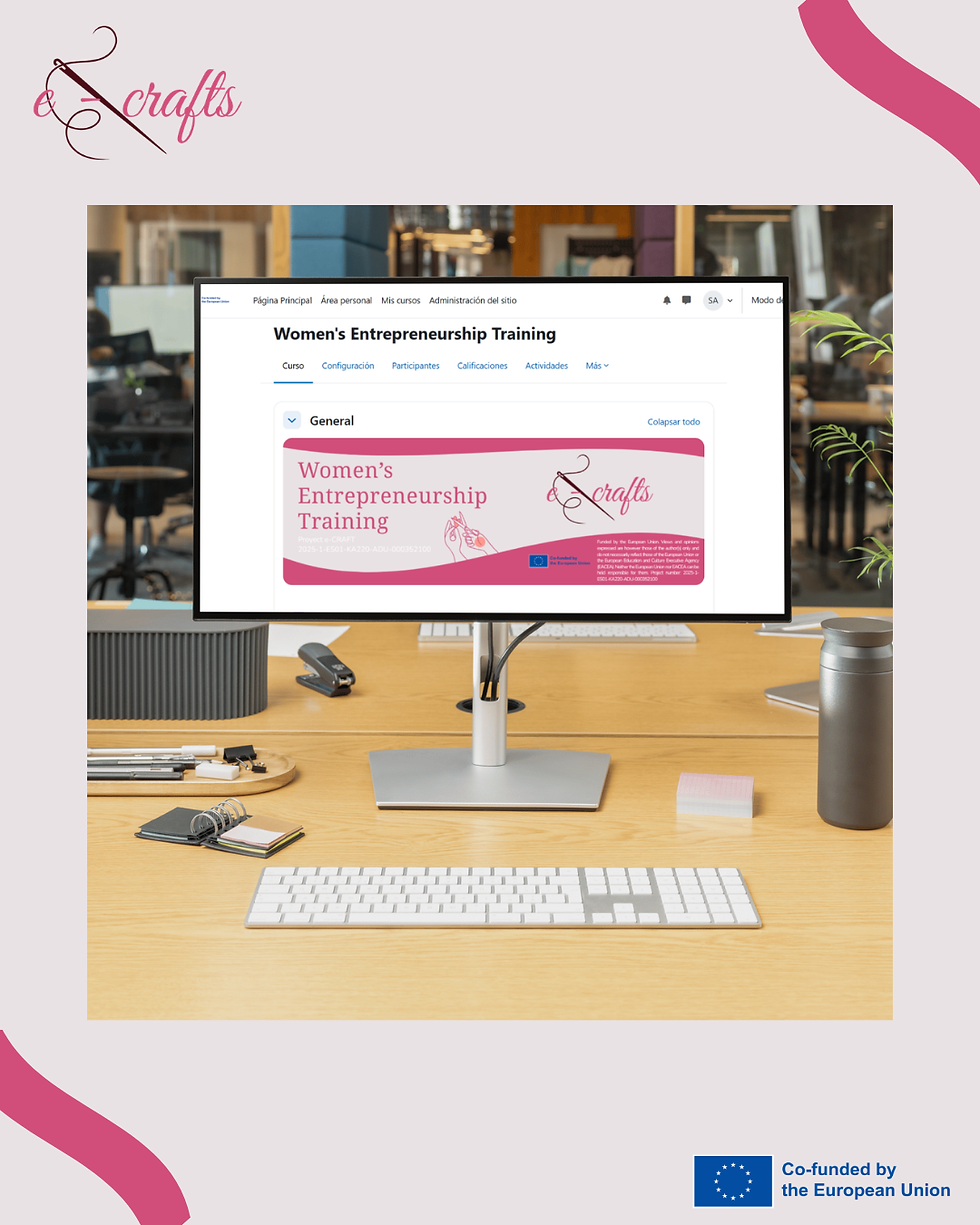
E-CRAFTS recognises this potential. The project supports women who already have craft skills but need help to connect those skills with digital entrepreneurship and e-commerce. Through training, workshops, mentoring and the E-CRAFTS digital platform, the project creates a bridge between traditional skills and modern market opportunities [1].
Why mentoring matters
Many entrepreneurship journeys fail not because the idea is weak, but because the person behind it is isolated. A new entrepreneur often has questions: Is my price realistic? How do I describe my product? Which platform should I use? How do I manage customer expectations? What should I do if I receive no orders? How can I improve my presentation?
Mentoring helps answer these questions in a human and practical way. It gives participants the chance to receive guidance from people with experience. It also helps transform training into action. A module can explain branding, but a mentor can help a participant understand how her own story, product and values can become part of a brand.
The European Commission has also recognised the importance of women’s entrepreneurship support through tools, networks and initiatives that focus on confidence-building, exchange of good practices and access to opportunities [5]. Similarly, EIGE has highlighted women’s digital inclusion as an empowering process that enables women to participate, innovate and shape their own future [6].
For E-CRAFTS, mentoring is therefore not an additional activity. It is central to the project’s impact. It helps women move from “I learned something” to “I can try this in my own work.”
From individual learning to community impact
When one woman artisan strengthens her digital and entrepreneurial skills, the benefit can extend beyond her own income. Her family may benefit from greater economic stability. Her community may benefit from the preservation of local craft traditions. Other women may see her progress and feel encouraged to start their own journey.
This is why E-CRAFTS also focuses on support networks and stakeholder engagement. Local organisations, adult educators, social workers, women’s associations, craft communities, municipalities and social economy actors can all play a role. They can help identify participants, provide spaces, share information, connect women with opportunities and continue supporting them after the end of the project.
The European Commission underlines that the social economy and inclusive entrepreneurship can contribute to job creation, work integration and sustainable growth [7]. This approach is closely connected to the vision of E-CRAFTS: digital craft entrepreneurship should not be seen only as individual self-employment, but also as part of a wider ecosystem of inclusion.
Sustainability means continuing after the project ends
A successful project is not measured only by what happens during its implementation. It is also measured by what remains afterwards.
For E-CRAFTS, sustainability means that the MOOC, training materials, platform, mentoring practices and partnerships can continue to be useful after the project period. It also means that the knowledge generated by the project can be reused by adult education providers, NGOs, community centres and other organisations working with women at risk of exclusion.
This is especially important because digital transformation does not stop. Platforms change, customer habits change and new tools appear. Women artisans need not only one training opportunity, but a foundation that allows them to keep learning and adapting.
The E-CRAFTS model responds to this need by combining accessible training, practical application, mentoring and cooperation among European partners. It offers a pathway that can be adapted to different local contexts while keeping a common objective: helping women transform their craft skills into sustainable opportunities.
A shared responsibility
The future of women’s craft entrepreneurship depends on more than technology. It depends on whether communities, institutions and support organisations are willing to create the conditions for women to participate fully in the digital economy.
Digital tools can open doors. Mentoring can help women walk through them. Networks can help them stay there. Sustainability can ensure that the door remains open for others.
E-CRAFTS is built on this idea. It is not only about helping women sell handmade products online. It is about recognising their skills, strengthening their confidence, connecting them with others and supporting their right to economic autonomy.
In the end, every handmade product has a story. Through E-CRAFTS, more women will have the tools, support and visibility to tell that story to the world.
References
E-CRAFTS Project Documentation. (2025). KA220-ADU-6306B917: Fostering local craft and e-commerce for women at risk of social exclusion. https://www.ecraftsproject.eu/
Eurostat. (2025). Skills for the digital age. https://ec.europa.eu/eurostat/statistics-explained/index.php?title=Skills_for_the_digital_age
Eurostat. (2025). E-commerce statistics. https://ec.europa.eu/eurostat/statistics-explained/index.php?title=E-commerce_statistics
Eurostat. (2025). Culture statistics - gender equality. https://ec.europa.eu/eurostat/statistics-explained/index.php?title=Culture_statistics_-_gender_equality
European Commission. Women entrepreneurs. https://single-market-economy.ec.europa.eu/smes/learn-and-plan-entrepreneurship/women-entrepreneurs_en
European Institute for Gender Equality. Digital Agenda. https://eige.europa.eu/gender-mainstreaming/policy-areas/digital-agenda
European Commission. Social economy and inclusive entrepreneurship. https://employment-social-affairs.ec.europa.eu/policies-and-activities/eu-employment-policies/social-economy-and-inclusive-entrepreneurship_en
Comments